Most business owners in Kerala ask us the same thing first: what kind of website do I need? The honest answer depends on one question: how often will you change what is on it? This guide explains static, dynamic and e-commerce websites in plain words, so you can choose without paying for things you will not use.
You will also see our real prices, local examples for each type, and a short checklist.
What is a static website?
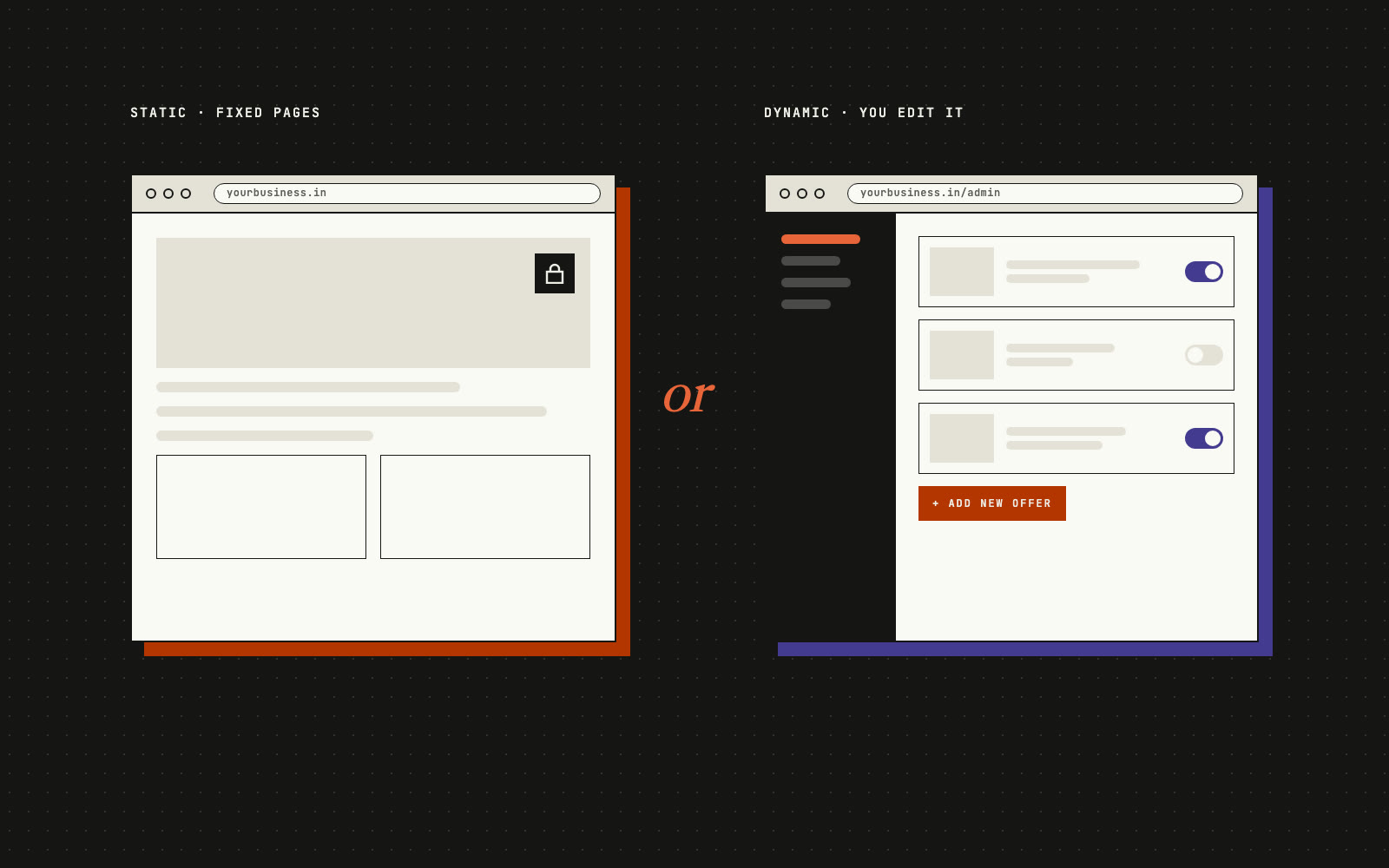
A static website is a set of fixed pages that look the same for every visitor. Think of it like a printed brochure, but online. Your pages are made once and saved as ready files, which are sent straight to the visitor's phone.
This brings three benefits:
- Fast: pages are ready in advance, so they open quickly, even on a slow mobile connection.
- Cheap to host: hosting means renting space on a computer that keeps your site online all day. Simple files need very little of it.
- Safer: there is no database and no login page for hackers to attack. Contentful explains that removing the database removes a whole group of common attacks.
The one downside: you cannot change the content yourself. If your phone number or timings change, the developer has to update the page for you.
What is a dynamic website?
A dynamic website keeps your content in a database, so you can change it yourself any time. A database is an organised store of information, like a digital register. When a visitor opens a page, the site picks the latest content from this register and shows it.
You make changes through an admin panel. This is a private page, protected by a password, where you can add a photo, write a news post or change an offer, a bit like posting on Facebook. The software behind it is called a CMS (content management system). It lets people update a site without writing code. WordPress is the best known example.
The trade-off is that a dynamic site has more moving parts. The software needs regular updates and backups to stay safe, and it is a little more work to build. That is why it costs more than a static site.
When do you need an e-commerce website?
You need e-commerce only when you want customers to choose products, pay and order on the website without talking to you. An e-commerce site has product pages, a cart, online payments and a place for you to see and manage orders.
Many small shops in Kerala start by taking orders on WhatsApp, and that works well when orders are few. It starts to get hard when you spend hours every day sending prices, checking payments and tracking who ordered what. Then a proper online store saves time and builds trust with new buyers.
Tip: if most of your sales still happen in person or on a phone call, you probably do not need e-commerce yet. A dynamic site with a clear WhatsApp button may be enough.
Static, dynamic and e-commerce side by side
The main difference is who updates the site and what it can do. Here is a simple comparison of our three plans.
| Feature | Static | Dynamic | E-commerce |
|---|---|---|---|
| Price (one-time) | ₹8,000 | ₹15,000 | ₹25,000 |
| Yearly renewal | ₹2,500 | ₹2,500 | ₹2,500 |
| Best for | Information that rarely changes | News, photos or offers added often | Selling products online |
| Who updates content | Developer | You, through the admin panel | You, through the admin panel |
| Mobile-friendly design, WhatsApp and call buttons, contact form | Yes | Yes | Yes |
| Blog or news section and photo gallery | No | Yes | Yes |
| SEO setup | No | Basic SEO | Basic SEO plus product SEO |
| Product pages, cart, online payments, order management | No | No | Yes |
SEO means setting up your pages so Google can understand them and show them in search results. The ₹2,500 yearly renewal covers hosting, SSL, updates and backups for every plan. SSL is the small lock icon next to your web address. It means the connection between the visitor and your site is encrypted, or scrambled, so others cannot read it.
Which type fits your business?
Match the website to how often your information changes, not to how big your business is. Here are some common examples from Kerala.
Static fits well
- A plumber or electrician whose services, area and phone number stay the same for years.
- A tuition centre that needs to show its courses, timings, location and a contact form.
Dynamic fits well
- A restaurant that changes its menu, specials or festival offers often.
- A clinic that wants to post health tips and doctor timings.
- A builder who adds photos of each new project as it is finished.
E-commerce fits well
- A shop that wants to sell sarees, spices, snacks or handicrafts to buyers across India.
- Any business that gets more product orders than it can handle by chat.
Ask yourself these questions
Five quick questions will point you to the right plan.
- Will I need to change something on the site more than once a month? If yes, think dynamic.
- Do I want to post photos, news or offers myself, without calling anyone? If yes, think dynamic.
- Do I want people to pay for products on the website? If yes, think e-commerce.
- Is my main goal just to look professional and get calls or WhatsApp messages? If yes, static is enough.
- Will I or my staff really have time to update the site? If not, a dynamic site will sit unchanged, and static may be the smarter choice.
Can you start small and upgrade later?
Yes, starting with a static site and upgrading later is a sensible choice. A static site gets you online quickly at the lowest cost. If you later find you want to post offers or photos yourself, the site can be moved to a dynamic setup. In most cases your existing design and content can be reused as the starting point.
Do not pay for a feature only because it sounds good. Pay for it when you know you will use it.
Key takeaways
- Static sites are fast, safe and low cost, but the developer makes the changes.
- Dynamic sites let you update photos, news and offers yourself through an admin panel.
- Choose e-commerce only when you want customers to order and pay on the website.
- Pick based on how often your information changes, not on how big your business is.
- Starting static and upgrading later is a fine plan.
Frequently asked questions
Can I upgrade from static to dynamic later?
Yes. In most cases your existing design and content can be reused, and the admin panel, blog and gallery are added on top.
Is a static website bad for Google?
No. Google does not rank a site higher just because it is static or dynamic. Clear content, a fast mobile site and good basic setup matter more.
Do I need to know coding to use the admin panel?
No. If you can post a photo on Facebook or WhatsApp, you can add a photo or offer in the admin panel.
What does the ₹2,500 yearly renewal cover?
It covers hosting to keep your site online, SSL for the lock icon, updates and backups. It is the same for all three plans.